

Pour a cup of saffron coffee and you’ll see it before you taste it. The coffee takes on a warm amber glow, and then the scent reaches you: floral, a little honeyed, with a soft note that reminds us of fresh hay. It’s a small moment, but it changes the whole morning.
That cup is why Saffronate exists. We infuse hand-harvested saffron from Herat, in western Afghanistan, into specialty beans from Brazil, Ethiopia and Colombia. So what makes the two taste so good together, and what does the science actually say about saffron coffee benefits? Here’s the honest answer, starting with the cup itself.
In short: Saffron coffee pairs the roasted depth and pleasant bitterness of specialty coffee with saffron’s floral aroma, honeyed notes and golden colour. Coffee and saffron have each been studied on their own, and saffron extract has shown promise in clinical trials. Those trials used standardised capsules, though, not saffron in a drink, and no study has tested saffron coffee itself. What you’ll notice straight away is the flavour, aroma and colour.
It’s coffee brewed with saffron threads, or ground coffee infused with saffron before it reaches you. The pairing has deep roots. Across the Gulf, traditional Arabic coffee, or qahwa, is often brewed with cardamom and saffron, which turns it a bright golden yellow. Saffron itself has a history stretching back more than 4,000 years, according to Penn State Extension.
What we’ve added is specialty coffee. Ask people what “specialty” means and, as Spencer Turer wrote in Roast Magazine, ‘you will get more opinions than people surveyed.’ Coffee pioneer Erna Knutsen coined the term in a 1974 Tea & Coffee Trade Journal article to describe the exceptional coffees standing out at the cupping table, and today the Specialty Coffee Association publishes the standards the industry works to.
Put the two ingredients next to each other and they look like opposites. One is a roasted seed, dark and deep. The other is the dried thread of a flower, delicate and bright. That contrast is exactly why they work.
| Coffee | Saffron | |
| Where it comes from | The roasted seeds of the coffee plant. Ours are specialty beans from Brazil, Ethiopia and Colombia. | The dried stigmas of the Crocus sativus flower, three per flower, picked by hand. Ours come from Herat. |
| Aroma | Roasty and toasty, created during roasting | Floral and honeyed, with a soft hay-like note |
| Flavor | Full-bodied, with a pleasant bitterness balanced by acidity | A gentle, earthy bitterness with a floral lift |
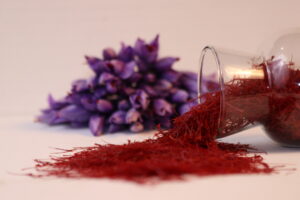
| Key compounds | Caffeine, chloro\genic acids and the bitter compounds roasting forms from them | Crocin (color), picrocrocin (taste) and safranal (aroma) |
| What it brings to the cup | Depth, body and the caffeine lift | Golden colour, a floral top note and a softer bitterness |
Coffee’s flavor is built in the roaster. Its roasty aroma comes from reactions such as the Maillard reaction and caramelisation, as C&EN reports, and its bitterness mostly comes from chlorogenic acids, which aren’t bitter themselves.
Food chemist Thomas Hofmann and his team found that roasting breaks them down into two families of bitter compounds: lactones, which give light and medium roasts their milder bitterness, and phenylindanes, which bring the harsher bite of dark roasts. As Hofmann told C&EN, roasting temperature shapes both the aroma and ‘the correct ratio between bitter and acid flavor.’ A good cup, as coffee scientists describe it, balances aroma, acidity, bitterness and body.
Saffron’s flavour comes from somewhere else entirely. Its taste comes from picrocrocin, and its aroma from safranal, which forms from picrocrocin as the threads dry, according to the Drugs.com monograph on saffron. In a sensory study of Italian saffron, the more safranal a sample contained, the stronger tasters rated its aroma.
Here’s why we think they make such a good match. Both bring bitterness, but from completely different sources, so saffron’s gentle, earthy bitterness sits alongside coffee’s roasted bitterness rather than piling on top of it. Saffron’s floral, honeyed aroma lifts off the top of the cup, a bright note over coffee’s deeper roasted base. And crocin, which dissolves readily in water, turns the whole cup a warm gold. The result is floral on the nose, smooth and round to drink, with a quiet earthy finish.
Want the saffron to lead? Our Saffron Premium Coffee carries a stronger infusion. Prefer the coffee up front with a softer golden note behind it? That’s our Saffron Gold Coffee.
Harvard’s Nutrition Source calls coffee ‘an intricate mixture of more than a thousand chemicals.’ The two that get the most attention are caffeine and chlorogenic acids, the antioxidants that researchers have linked to lower inflammation. Harvard notes that 50 to 300 mg of caffeine can leave you more alert, energetic and focused, while higher amounts can bring anxiety, restlessness and poor sleep.
Saffron has a growing body of clinical research. In a 2024 systematic review, Shufen Han, Yifei Cao and their colleagues pooled 46 randomized controlled trials and found saffron outperformed placebo for memory and thinking, low mood, anxiety and sleep problems. Their conclusion: saffron is ‘a relatively favorable and safe treatment.’ An earlier NIH-supported review by Heather Hausenblas and colleagues found benefits for depressive symptoms, PMS and sexual function across 12 trials, and a 2022 overview by Ahmad Shamabadi, Alireza Hasanzadeh and Shahin Akhondzadeh described saffron as ‘beneficial, safe, and tolerable.’
Researchers are also clear about the limits. A 2021 review in the journal Phytomedicine found saffron safe and able to improve a range of outcomes, but added that ‘the scientific quality of the published systematic reviews needs to be improved.’

Is saffron coffee good for you? For most healthy adults, coffee in moderation can be part of a healthy diet, as the FDA notes, and saffron is generally not associated with toxicity in the amounts used in food, according to the Drugs.com monograph. Whether saffron adds anything extra to your coffee’s health profile is a different question.
It’s easy to see why scientists find the pairing interesting. Coffee and saffron bring antioxidants from two different chemical families: coffee’s chlorogenic acids and saffron’s carotenoids, such as crocin. And saffron has been studied for mood, anxiety and sleep, the very areas where too much caffeine can cause trouble.
But that’s where the evidence stops. No study has tested saffron coffee itself, and research on each ingredient on its own doesn’t prove any added health benefit when you combine them in a cup. We’d rather tell you that plainly than promise something the science hasn’t shown.
The clinical trials above didn’t use saffron coffee. They gave people standardized saffron extract in capsules, at carefully measured doses. For mood, Drugs.com notes, trials have typically used 20 to 30 mg of extract a day over 6 to 12 weeks. In one placebo-controlled trial led by Adrian Lopresti, 202 adults took 28 mg of a standardized extract daily for 12 weeks. (Two of the authors worked for the company that made it.)
Saffron in coffee is different. It’s there as a spice, for flavor, aroma and color, and it isn’t standardized or measured the way trial extracts are. So please don’t expect a cup of saffron coffee to have the mood or sleep effects reported in those studies. Enjoy it for what it is: a beautiful cup of coffee.
Not all saffron is equal, and there’s an international standard to prove it. ISO 3632 grades saffron in a lab by measuring its colouring strength (crocin), flavour strength (picrocrocin) and aroma strength (safranal), then sorts it into categories, with Category I at the top, as a 2024 review of saffron quality explains. Colouring strength is also what sets saffron’s value in international trade, according to published research.
Much of that quality is decided after the harvest. Safranal only forms as the threads dry, and Penn State Extension notes that drying is what develops saffron’s aroma and potency. Margaret Skinner, who co-leads the University of Vermont’s saffron research centre, put it simply on the University of Wisconsin-Extension’s Cutting Edge podcast: ‘it’s critical that the stigmas are dry.’ Threads that aren’t dry enough, she explained, go mouldy in the jar.
Our saffron comes from Herat, the province that grows about 90% of Afghanistan’s saffron, TOLOnews reports. Herat saffron has taken first place for quality at the International Taste Institute’s competition in Brussels ten years running, up against saffron from Iran, Spain and Greece, and Khaama Press reported that judges praised it for its ‘intense coloring strength, rich aroma, and balanced flavor.’
Every batch of our saffron is graded ISO 3632 Category I and comes with a certificate of analysis.
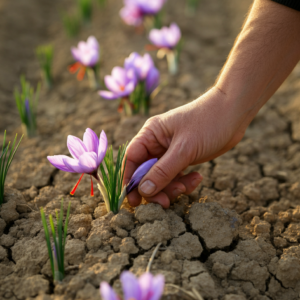
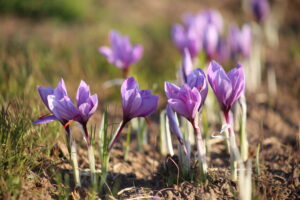
Saffron’s price makes sense once you see the work behind it. Each crocus flower gives just three threads, picked by hand in the morning once the dew has dried and before the sun wilts the flower, which only lasts a day. Penn State Extension estimates it takes about 4,000 blossoms to make a single ounce, and a whole acre produces only about three pounds. Master Gardeners Shawn Marie Lane and Karen Hartman call saffron ‘the most expensive spice in the world and for good reason.’
The University of Vermont’s saffron research centre puts retail saffron at around $5,000 a pound, and on that same Wisconsin-Extension podcast, Skinner said US growers sell theirs for $30 to $50 a gram, if they’re lucky. Demand is real, too: her UVM colleague Arash Ghalehgolabbehbahani noted the US imported more than 71 tons of saffron in 2019.
So a bag of Saffronate carries more than great beans. It carries a hand-picked spice that costs more per gram than almost anything else in your kitchen, from one of the most celebrated saffron regions in the world.
For most healthy adults, a sensible saffron coffee dosage per day is set by the caffeine, not the saffron.
The FDA cites 400 mg of caffeine a day as an amount not generally linked to negative effects for most adults, though how much is too much varies with body weight, medications, health conditions and sensitivity. The caffeine in your cup varies too. Harvard puts an 8-ounce cup of brewed coffee at about 95 mg, while University of New Hampshire Extension puts a typical 12-ounce cup anywhere from about 113 to 247 mg. Serving size, the beans and how you brew all make a difference.
As for how much saffron in coffee is safe, the research on saffron’s safety looks at far larger amounts. Drugs.com notes that doses of up to 1.5 g a day are thought to be safe, with toxic effects reported at 5 g. That’s far more than you’d ever use to flavour a cup.
We like Saffron Gold Coffee for everyday mornings and Saffron Premium Coffee for slower ones.
Saffron coffee side effects mostly come down to caffeine. Still, a few people should talk to their doctor before making it a daily habit.
Allergic reactions to saffron are uncommon, but they have been reported. This is general information, not medical advice, so if you take prescription medicine, please check with your doctor first.
That depends on what you mean by “work.”
If you’d like to taste it before committing, our Saffron Gold Coffee sample is an easy first step.
Yes, you can put saffron in coffee at home, and there are two easy ways to do it.
Saffronate brings together two things we love: hand-harvested saffron from Herat, in western Afghanistan, and specialty coffee from Brazil, Ethiopia and Colombia. Our saffron is graded ISO 3632 Category I, and every batch comes with a certificate of analysis. We infuse it into our beans and roast to order in small batches, so your coffee arrives fresh.
Ready to try it? Start with our Saffron Gold Coffee sample and see how it fits your mornings.
Once you’re hooked, Saffron Gold Coffee makes a lovely everyday cup, and Saffron Premium Coffee is there when you want saffron front and centre.
Like to brew your own way? Our Saffron Premium Threads are ready to steep.
No. Saffron is a spice and has no caffeine. All the caffeine in saffron coffee comes from the coffee beans, and the amount depends on the serving size and how the coffee is brewed. Harvard puts an 8-ounce cup of brewed coffee at about 95 mg.
A small pinch of threads is plenty. Steep it in a couple of tablespoons of warm water for about 20 minutes, then stir it into your brewed coffee and adjust to taste. It’s there for flavour, aroma and colour, not as a measured dose like the extracts used in clinical trials.
You’ll notice saffron’s flavour, aroma and colour straight away, and caffeine peaks in the blood anywhere from 15 minutes to 2 hours. Research hasn’t shown whether, or when, saffron in coffee has any mood or sleep effects. The clinical trials used standardised extract, not saffron coffee.
Yes, most healthy adults can enjoy it daily. The limit comes from caffeine: the FDA cites 400 mg a day as an amount not generally linked to negative effects for most adults. If you’re pregnant, take blood thinners or have a bleeding disorder, check with your doctor first.
Writer: Areeba Amin