

Saffron and specialty coffee have each been studied separately, and saffron-infused coffee is now sold as a flavor product. This article reviews the published research on each ingredient and on the pairing. Findings on coffee come mainly from observational studies and from trials of caffeine. Findings on saffron come mainly from randomized trials of capsules, tablets, and extracts. No study has evaluated saffron and coffee together, so health findings for either ingredient cannot be applied to the combination. The article also covers safety considerations, laboratory findings on heat and saffron compounds, and how saffron quality is graded under ISO 3632.
This article is for educational purposes. Research findings discussed relate to coffee, caffeine, or saffron studied separately and do not establish health benefits for Saffronate Coffee. Saffronate Coffee is marketed as a food and beverage, not as a treatment or prevention for any medical condition.
Saffron, the dried stigma of Crocus sativus, has been used for an estimated 4,000 to 5,000 years as a dye, seasoning, perfume, and medicine, and it has long ranked among the most expensive spices [1]. Specialty coffee is a major consumer category. In the United States, 47% of adults reported drinking specialty coffee in the past day in 2026, matching the record set in 2025 and exceeding the 42% who reported drinking traditional coffee [2].
This article reviews what is known about each ingredient and about their combination. It covers grading and flavor, findings for each ingredient individually, dosage, safety, and brewing. No clinical study of saffron combined with coffee was identified in the sources reviewed. Statements about the pairing are therefore limited to flavor chemistry and to a single study of saffron and caffeine metabolism. Results from saffron supplement studies cannot be assumed to apply to a brewed cup of coffee.
Specialty coffee has traditionally been defined by a cupping score of 80 points or above on a 100-point scale. The convention dates to the cupping form released by the Specialty Coffee Association of America in 2004 [3]. Under it, scores of 85 and above are generally associated with single-origin lots and scores of 90 and above with rare, premium selections [3]. The threshold is a sensory grading convention. The Specialty Coffee Association (SCA) has since introduced the Coffee Value Assessment, whose descriptive assessment uses check-all-that-apply descriptors and intensity rankings, in response to the view that numbers alone communicate little about a coffee [4].
Post-harvest processing has been shown to change the metabolite profile of green Arabica coffee beans [5]. Roasting further changes the composition, as shown in a study of brewed Colombian Arabica, in which chlorogenic acid degrades with increasing roasting time [6].
Chlorogenic acid is the predominant phenolic compound in coffee brews [6]. In brewed Colombian Arabica, light-roasted beans showed the highest antioxidant activity, and approximately 40-80% of that activity was lost with further roasting [6]. In specialty beans from Colombia and Nicaragua, light roasting maintained similar amounts of caffeine and total polyphenols, whereas darker roasting reduced acrylamide [7]. These are compositional and laboratory measurements, and they do not establish health effects in people.
In a placebo-controlled study, 100 mg of caffeine, administered in fruit juice after overnight abstinence, increased self-rated alertness in both regular caffeine consumers and non-consumers [8]. That study tested caffeine in a single dose, not brewed coffee.
An umbrella review of 201 meta-analyses of observational studies found that coffee consumption was more often associated with benefit than harm, with the largest risk reductions at three to four cups per day [9]. Associations were reported with all-cause mortality, cardiovascular disease, type 2 diabetes and depression [9]. The authors noted that the evidence is observational, called for randomized trials to establish causality, and identified pregnancy and high fracture risk in women as exceptions [9].
The U.S. Food and Drug Administration cites 400 mg of caffeine per day as an amount not generally associated with negative effects in healthy adults, and lists insomnia and anxiety among the effects of excessive intake [10]. A systematic review of trials and epidemiological studies reported that caffeine prolonged sleep latency and reduced total sleep time [11]. The American College of Obstetricians and Gynecologists states that moderate caffeine consumption, defined as less than 200 mg per day, does not appear to be a major contributing factor in miscarriage or preterm birth [12].
A narrative historical review attributes to Avicenna’s Canon of Medicine a recommendation for saffron in depression, and to the Chinese text Shennong Bencaojing its use for poor memory [1]. The same review reports that Iran accounts for approximately 85% of world saffron production, citing Food and Agriculture Organization data, and notes inconsistencies in the dating and attribution of historical sources [1]. Traditional use does not establish efficacy.
Saffron quality is graded according to ISO 3632 using absorbance values at 440 nm for crocin (coloring power), 257 nm for picrocrocin (bittering power), and 330 nm for safranal (odorous power) [13]. Category I requires a coloring value of at least 200, a bittering value of at least 70, and an odorous value between 20 and 50, with moisture below 12% for filaments [13]. Categories II and III have lower thresholds [13]. The same study reports that the method quantifies safranal poorly, so odorous power can misclassify samples [13].
Clinical research on saffron concerns supplements, not beverages or Saffronate products. These findings do not establish that Saffronate Coffee treats depression or anxiety. A meta-analysis of 23 randomized trials with 1,237 participants reported lower depression and anxiety symptom scores with saffron than with placebo, with large pooled effect sizes (g of 0.99 for depression and 0.95 for anxiety) [14]. Preparations included stigma, petal, crocin extract, and whole powder forms, most commonly at 30 mg per day (19 of 23 trials), for 4 to 12 weeks, with six weeks the most frequent duration [14]. A separate meta-analysis reported that saffron was more effective than placebo and not significantly different from conventional antidepressants in mild to moderate depression, with no significant difference in adverse-effect incidence [15].
The evidence has limits. The authors of the 23-trial meta-analysis reported strong evidence of publication bias, small sample sizes, and geographic concentration, with 13 of the 23 trials from a single region [14]. All trials in another meta-analysis were conducted in Iran and used capsules, tablets or extracts [16]. Results from these supplement trials cannot be assumed to apply to saffron steeped in a beverage, because the preparation, dose and frequency differ.
The table summarises findings for each ingredient separately. No entry describes a tested effect of the combination.
| Outcome | Coffee (caffeine) | Saffron preparations |
| Self-rated alertness | Increased after 100 mg caffeine versus placebo, single dose [8] | Not assessed in the studies reviewed |
| Anxiety | Listed among effects of excessive caffeine intake [10] | Lower symptom scores than placebo in supplement trials, with the limitations above [14] |
| Depressive symptoms | Lower depression risk associated with coffee in observational data [9] | Lower scores than placebo; not significantly different from antidepressants in mild to moderate depression [14][15] |
| Sleep | Longer sleep latency and shorter total sleep time [11] | Not assessed in this review |
| Study design | Observational studies [9]; a short placebo-controlled study of caffeine [8] | Randomized trials of capsules, tablets and extracts [14][16] |
| Duration | Single dose [8] | 4 to 12 weeks [14] |
Findings were generated with different preparations, doses and time courses. They are not interchangeable and cannot be added together to predict the effect of a single beverage. No study identified in this review evaluated how saffron affects alertness, anxiety or sleep outcomes related to caffeine.
The sensory attributes of saffron are linked to specific compounds, with picrocrocin associated with bitterness and safranal with aroma [13]. No sensory study of saffron added to brewed coffee was identified in this review, so effects on perceived bitterness, acidity or aroma are not documented in the literature reviewed.
The only study identified that examined saffron in relation to caffeine measured caffeine metabolism. In 34 healthy volunteers who consumed a saffron infusion for six days, activity of the enzyme CYP1A2, which metabolizes caffeine, decreased by approximately 13.7% in saliva-based measurements and 6.0% in urine-based measurements, with a larger reduction in men than in women [17]. The authors concluded that significant herb-drug interactions were unlikely, with a possible exception for CYP1A2 substrates in men [17]. This finding concerns caffeine metabolism. It does not show that saffron changes the effects of caffeine or increases the benefits of either ingredient.
Saffronate offers saffron-infused coffee, Saffron Gold Coffee, a sample size, and saffron threads [18]. Each 12 oz container provides approximately 23 servings of 15 g coffee. This serving weight refers to coffee, not saffron content. The saffron content in milligrams per serving has not been verified for this article. [18];
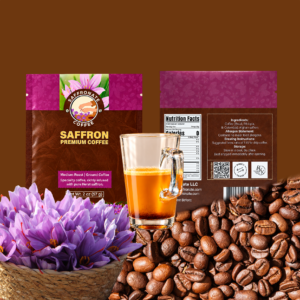
In the trials reviewed, saffron was most commonly given at 30 mg per day as capsules, tablets or extracts [14][16]. Each 12 oz container of Saffronate Coffee provides approximately 23 servings of 15 g coffee [18]. This is the weight of the coffee serving, not the amount of saffron. The saffron content in milligrams per serving has not been verified for this article. No study identified here evaluated a serving of Saffronate Coffee, and trial preparations differ in composition and delivery from saffron steeped in a drink [14][16].
Saffron coffee may suit adults who drink coffee and wish to try an additional flavor. No health benefit of the beverage has been demonstrated.
Culinary and supplement use differ. Culinary amounts of saffron are not generally associated with toxicity [20], but reports of toxicity at higher doses do not establish a universally safe threshold [19][20]. A systematic review of 102 clinical trials of Crocus sativus preparations estimated that adverse events related to its use occurred in about 17.5%, most commonly as mild, self-limiting gastrointestinal complaints, and advised clinical monitoring for medicinal use at higher doses or over longer periods [21]. These findings concern the preparations and doses studied and cannot establish the safety of every beverage formulation, including Saffronate Coffee. The following precautions apply:
The trials reviewed administered saffron for 4 to 12 weeks, most commonly for 6 weeks [14]. A trial duration describes the length of treatment and the point at which outcomes were measured. It does not indicate when effects begin. No study identified in this review examined the time course of effects of saffron-infused coffee, so any timeline for a brewed beverage is unknown.
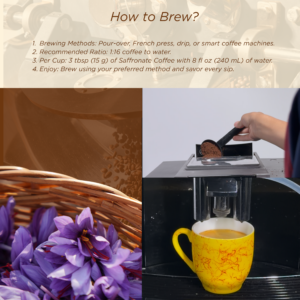 In a laboratory study, crocin degradation followed first-order kinetics and was faster at higher temperatures (60, 70, 80 and 90 °C were tested) and at lower pH (2, 4.5 and 6 were tested) [23]. Safranal was identified as the major volatile compound of saffron extract [23]. The study examined saffron extract and microcapsules but not brewed coffee. The retention of saffron constituents under different brewing temperatures, contact times, and coffee acidities has not been quantified in the studies reviewed. The preparation method may influence the crocin content, the compound associated with color [13][23], but its effects on the chemical composition of the final beverage and on any health outcomes have not been established.
No sensory study of saffron in coffee was identified. Saffron’s bitterness and aroma are linked to picrocrocin and safranal [13].
No evidence-based amount for a beverage has been established. Trials of saffron supplements most commonly used 30 mg per day [14] and do not apply directly to a brewed cup. Each 12 oz container of Saffronate Coffee provides approximately 23 servings of 15 g coffee [18]. This serving weight refers to coffee, not saffron content. The saffron content in milligrams per serving has not been verified for this article.
Culinary amounts of saffron are not generally associated with toxicity [20], and the FDA cites 400 mg of caffeine per day as an amount not generally associated with negative effects in healthy adults [10]. The long-term effects of daily saffron coffee have not been studied. Individuals who are pregnant, breastfeeding, or taking medication should consult a health care provider [10][20].
No clinical study of the combination was identified. One study found reduced CYP1A2 activity after six days of saffron infusion, mainly in men [17]. Excess caffeine is associated with insomnia and anxiety [10], and mild gastrointestinal events were the most common adverse events in saffron trials [21].
The evidence reviewed supports saffron coffee mainly as a flavor experience. Specialty coffee is graded by sensory quality [3], and saffron quality is specified by ISO 3632 criteria for coloring, bittering, and aroma compounds [13]. Stated grade and certification allow each ingredient to be evaluated [3][13]. Findings on the health effects of coffee [9] and saffron supplements [14] are separate, and no study has tested their combination.
For readers interested in the flavor, Saffronate offers saffron-infused coffee and saffron threads, and a sample lets them assess the flavor before purchasing a full-size product [18].
Writer: Kelly Knight
[1] Wenger T. History of saffron. Longhua Chinese Medicine 2022;5. Semmelweis University. doi:10.21037/lcm-21-67. https://lcm.amegroups.org/article/view/8189/html
[2] National Coffee Association and Specialty Coffee Association. 2026 National Coffee Data Trends Specialty Coffee Report. Released June 2, 2026. https://www.ncausa.org/Newsroom/Specialty-Coffee-Consumption-Remains-at-Record-High
[3] Royal Coffee. Scoring Specialty Coffee: What Do the Numbers Mean? https://royalcoffee.com/scoring-specialty-coffee-what-do-the-numbers-mean/
[4] Specialty Coffee Association. The Coffee Value Assessment (CVA) in Action: The Descriptive Assessment. https://sca.coffee/sca-news/cva-in-action-descriptive-la6j8
[5] Impact of postharvest processing on the metabolite profile of Arabica green coffee beans. IPB University. https://journal.ipb.ac.id/jtep/article/view/66806
[6] Cho AR, et al. Influence of roasting conditions on the antioxidant characteristics of Colombian coffee (Coffea arabica L.) beans. Korea Institute of Science and Technology repository. https://pubs.kist.re.kr/handle/201004/126718
[7] Effect of roasting on polyphenols, acrylamide and caffeine in specialty coffee beans from Colombia and Nicaragua. PubMed Central PMC8226649. https://pmc.ncbi.nlm.nih.gov/articles/PMC8226649
[8] Smith A. Caffeine and ratings of alertness in the early morning. Cardiff University, 2021. https://orca.cardiff.ac.uk/id/eprint/139119/
[9] Poole R, et al. Coffee consumption and health: umbrella review of meta-analyses of multiple health outcomes. BMJ 2017;359:j5024. https://pmc.ncbi.nlm.nih.gov/articles/PMC5696634/
[10] U.S. Food and Drug Administration. Spilling the Beans: How Much Caffeine Is Too Much? Content current as of August 28, 2024. https://www.fda.gov/consumers/consumer-updates/spilling-beans-how-much-caffeine-too-much
[11] Clark I, Landolt HP. Coffee, caffeine, and sleep: a systematic review of epidemiological studies and randomized controlled trials. Sleep Medicine Reviews 2017;31:70-78. https://em-consulte.com/article/1111045/resume/coffee-caffeine-and-sleep-a-systematic-review-of-e
[12] American College of Obstetricians and Gynecologists. Committee Opinion No. 462: Moderate caffeine consumption during pregnancy. Obstet Gynecol 2010. https://pubmed.ncbi.nlm.nih.gov/20664420/
[13] Bergomi A, Comite V, Santagostini L, Guglielmi V, Fermo P. Determination of saffron quality through a multi-analytical approach. Foods 2022;11(20). https://pmc.ncbi.nlm.nih.gov/articles/PMC9601413/
[14] Marx W, et al. Effect of saffron supplementation on symptoms of depression and anxiety: a systematic review and meta-analysis. Nutrition Reviews 2019. Bond University. https://pure.bond.edu.au/ws/files/31402310/Effect_of_saffron_supplementation_on_symptoms_of_depression_and_anxiety.pdf
[15] Safety and efficacy of saffron (Crocus sativus L.) for treating mild to moderate depression: a systematic review and meta-analysis. J Nerv Ment Dis 2020;208(4):269-276. https://pubmed.ncbi.nlm.nih.gov/32221179/
[16] The efficacy of saffron in the treatment of mild to moderate depression: a meta-analysis. Planta Med 2019;85(1):24-31. https://www.thieme-connect.com/products/ejournals/html/10.1055/a-0660-9565
[17] Begas E, et al. Effects of short-term saffron (Crocus sativus L.) intake on the in vivo activities of xenobiotic metabolizing enzymes in healthy volunteers. Food Chem Toxicol 2019. University of Thessaly repository.
[18] Saffronate. Product pages: saffron premium coffee, Saffron Gold Coffee, Saffron Gold Coffee Sample, Saffron Premium Threads. https://saffronate.com/
[19] Saffron (Crocus sativus L.) review. CSIRO Publishing.
[20] Saffron. Natural Products monograph, Drugs.com (archived). https://www.drugs.com/npc/saffron.html
[21] Hasheminasab FS, Hajimonfarednejad M, Najibi SM, et al. Safety of Crocus sativus monopreparations in human studies: a systematic review. Health Science Reports. https://www.synapsesocial.com/papers/69f2a4578c0f03fd677634fe
[22] Nephrotoxicity and hepatotoxicity evaluation of Crocus sativus stigmas in neonates of nursing mice. J Nephropathol 2014. https://pmc.ncbi.nlm.nih.gov/articles/PMC3999588
[23] Karasu S, Bayram Y, Ozkan K, Sagdic O. Extraction optimization of crocin pigments of saffron (Crocus sativus) using response surface methodology and determination of stability of crocin microcapsules. J Food Meas Charact 2019. https://link.springer.com/doi/10.1007/s11694-019-00067-x